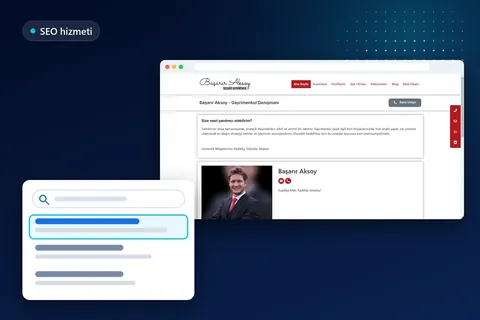
Psychologist website design is the planning and development of a website explaining who a psychologist, clinical psychologist, or psychological counselor is, which subjects they work on, how sessions proceed, and how to reach them, without intimidating someone at the decision stage. A professional looking for a therapist website usually does not need an elaborate showcase: they need plain language, an accurately written title, an appointment request asking for little information, and infrastructure protecting the client’s privacy.
The following sections explain field-specific decisions in order, from title wording to online sessions and from KVKK (Turkey’s Personal Data Protection Law) to promotional limits. Work is carried out from Maltepe; meetings with professionals in Istanbul take place in person or by video, and with those in other cities remotely.
Let’s define the pages that will welcome clients together
A few sentences describing your title, subjects you work on, and whether sessions take place in person or online are enough to start. The message is assessed free of charge, and the proposal is delivered the same day; a link to an existing website or social media account can be included if available.
Which pages should a psychologist website include?
The basic pages of a psychologist website cover the professional’s biography and title, subjects addressed, how sessions work, online consultation information, contact and appointment requests, and KVKK texts. A psychological counseling website is built on the same framework; which page takes priority depends on whether the professional works independently or in a center and where they meet clients.
| Working arrangement | Website focus | Prominent pages |
|---|---|---|
| A single professional’s office | The professional and how to reach the office | Biography, areas of work, session information, location, appointment request |
| A counseling center with multiple professionals | Helping clients find a suitable professional | Professional team, topic-based pages, the center’s working principles, shared inquiry form |
| A therapist working only online | Understanding the technical process and confidentiality | Online session process, consultation service used, working hours, data policy |
| Work focused on children, adolescents, and families | The parent’s decision process | Parent information page, planning the first consultation, family consultations |
For different working arrangements, the list is prepared during the initial meeting; every project delivers the following:
- An interface designed for phones: Call, WhatsApp, and appointment request options sit within easy thumb reach.
- A dashboard the professional can update: Working hours, articles, and session information can be changed through WordPress.
- Ownership and security: SSL, a privacy notice, cookie banner, and search engine settings; the domain and hosting are registered in the professional’s own name.
The technical framework is the same as in the corporate web design service; the difference is that texts and forms are written according to the sensitivities of mental healthcare.
How are clients’ privacy concerns reflected in the design?
Someone deciding to seek psychological support often reviews the website alone, late at night, and without telling anyone; the design’s first task is to avoid making them feel judged. Psychologist website design that avoids stigmatizing language describes situations in everyday words rather than placing diagnostic labels in headings: burnout at work, the period after a breakup, exam anxiety, or difficulties with parenting, for example.
Stock images showing people crying or burying their heads in their hands increase anxiety; the professional’s real portrait, consultation room, and building entrance are used instead. Several decisions are also made in the website’s unseen layer:
- No advertising pixels or third-party tracking code are placed at the addresses containing the appointment form or thank-you page.
- Confirmation emails and reminder messages do not mention the consultation topic; they state only the date and time.
- Page addresses and browser tab titles are chosen to be simple enough not to cause discomfort even on a shared phone.
- If it is unclear where messages in a live chat plugin are stored, the plugin is not used.
How are the titles clinical psychologist, psychologist, and psychological counselor written on the website?
The title line is written based on the program and degree on the professional’s diploma; these three titles are not defined in the same place or the same way in legislation. Law No. 1219 on the Practice of Medicine and Its Branches defines a clinical psychologist as a healthcare professional in Additional Article 13 and lists the educational routes leading to this title. The same article states that, in cases involving illness, a clinical psychologist may apply psychotherapy only on the basis of diagnosis and a treatment referral by the relevant specialist physician.
The Regulation on Job and Duty Descriptions of Healthcare Professionals and Other Professionals Working in Healthcare Services defines psychologists in its Annex 2 list for other professionals working in healthcare services. Neither of these texts contains a separate title definition for psychological counselors; an undergraduate degree in psychological counseling and guidance is mentioned in the Law as one of the routes toward the clinical psychologist title.
| Title | Location in the text | How it appears on the website |
|---|---|---|
| Clinical psychologist | Law No. 1219, Additional Art. 13, healthcare professional | “Clinical psychologist”; the relevant page states that work with diagnosed conditions takes place upon physician referral. |
| Psychologist | Job and Duty Descriptions Regulation, Annex 2 | “Psychologist”; therapy training is listed under education in the biography. |
| Psychological counselor | No separate definition in either text | A title faithful to the diploma’s program name; the service is described as “psychological counseling.” |
The word “therapist,” frequently used in searches, is not a title in these texts; it can be used in content but does not replace the official title in the title line. Certificates from therapy approaches appear as education in the biography; in cases of uncertainty, legal counsel’s opinion is taken as the basis.
How are areas-of-work pages and blog articles written without making diagnoses?
An areas-of-work page explains how an issue may appear in everyday life and how it is addressed in consultations; it does not diagnose the reader. Templates producing results from a symptom count and online tests suggesting labels are therefore not used.
The division of work in psychologist website design is clear: page layout and readability are prepared on the design side, while every sentence relating to mental health is written or approved by the professional. The promotion regulation also assigns information provision to professionals authorized in the relevant subject. The following principles apply to blog articles:
- The author’s name, title, and last update date are visible at the start of the article.
- The topic is connected to when speaking with a professional may be helpful rather than to readers assessing their own condition through the article.
- A real client’s story is not used as an example, even if details have been changed.
- An emergency note is added at the very top of articles on subjects such as suicide, self-harm, or abuse.
If a clinical psychologist writes about a diagnosed condition, the text states that work in this area takes place upon referral from a psychiatrist. Readers thus also learn whom to contact in which situation.

How are session information and appointment requests handled with minimal data?
The appointment request form asks for the minimum information needed to respond: a name, one contact method, an in-person or online preference, and a suitable range of days. The reason for applying, previous diagnoses, or medication used are not requested in the form; this conversation belongs in the first consultation.
The session information page reduces uncertainty before a decision and answers these questions:
- What is discussed in the first consultation and how long it lasts
- How frequently sessions are scheduled
- How far in advance notice is required for changing or canceling an appointment
- The scope of confidentiality and its limits under the professional’s code of ethics
The session fee is not written on this page; it is communicated by phone or correspondence to those who ask, with the basis explained in the promotional rules section.
A 112 note for crisis situations
A psychologist website is not an emergency support channel; forms and messages are answered during working hours. A short note immediately above the form, on the contact page, and in the footer states that the 112 Emergency Call Center should be called in life-threatening emergencies. The note is written calmly so as not to alarm readers, but placed where it cannot be missed.
Online therapy website: how is video consultation infrastructure connected?
On an online therapy website, video consultations are not hosted within the website; sessions take place on the consultation service selected by the professional, and the website provides a link and an information page preparing the client for that service. The choice of service depends on the type of institution in which the professional works.
For private healthcare facilities, the framework is the Regulation on the Provision of Remote Healthcare Services, published in the Official Gazette on February 10, 2022. The regulation lists psychosocial support among services that may be provided remotely, but requires a Ministry-authorized facility and a registered remote healthcare information system. The situation of an independent professional is clarified with legal counsel.
The information list in Article 9 of the regulation also provides a sound framework for an online session page:
- The professional and client will not be in the same physical environment, and remote services cannot be equivalent to in-person services
- During emergencies, the nearest emergency department should be contacted instead of having an online consultation
- No audio or video recording may be made without the parties’ explicit consent
- If a third person who could see or hear the consultation is present, this will be disclosed to the other party (Article 11)
In psychologist website design, general claims such as “end-to-end encrypted” or “completely secure” are not written; the service used is named, and a link to the provider’s own privacy statement is included. The cost of setting up the connection is determined in the proposal according to scope, while the service subscription is paid directly to the provider.
Let’s clarify the consultation channel and inquiry form together
When the consultation service, form fields, and number of professional profiles are discussed, the scope is put in writing. For work involving a calendar or consultation service connection, the proposal is prepared according to this written list.
KVKK: mental health data, forms, and email security
KVKK (Law No. 6698) lists special-category personal data exhaustively, and health appears on this list; information about mental health is part of this group too. Forms and file attachment areas where such information could be entered are listed at the start of the project.
Information coming from the form must be protected everywhere it reaches. In practice, the following measures are taken:
- Form submissions are kept in an area of the website dashboard accessible only to the professional and deleted when the specified period expires.
- The notification email does not carry the message content; it only reports that a new request has arrived.
- Website emails are sent from a domain-based business account with sender authentication configured.
- Dashboard access uses a strong password and two-step verification.
- The privacy notice is provided by a link beside the form; if explicit consent is needed, a separate checkbox is used.
General rules for health data on websites are also explained in the healthcare website guide .
Client reviews, session fees, and campaigns: how are promotional rules applied?
The main text governing healthcare promotion is the promotion and information regulation in Official Gazette No. 33075 (November 12, 2025). The regulation covers healthcare professionals, private healthcare institutions, and international health tourism intermediary organizations; because its definition of healthcare professionals includes the professions in Additional Article 13 of Law No. 1219, clinical psychologists fall within its scope.
Article 5 of the Job and Duty Descriptions Regulation stipulates that healthcare professionals and other professionals cannot carry out misleading or self-praising promotion, campaigns, or advertising, and may introduce only their name, title, field, and address. This framework turns into three concrete decisions in psychologist website design:
- Client reviews: The promotion regulation prohibits sharing patients’ or relatives’ words of gratitude and satisfaction for advertising purposes; in mental healthcare, a review itself also reveals that its author has received support. Review sliders, rating stars, and widgets pulling in external reviews are not added to the website.
- Session fees and campaigns: Fees, discounts, campaigns, and promotional information cannot appear in promotion; banners such as “first session free” or “session package discount” are not created, and gifts or prize draws are not used as incentives.
- Language of superiority and results: The regulation subjects search engine keywords and information on results pages to the same principles; titles and descriptions contain no comparisons, superiority claims, or promises of recovery.
How other requirements such as the last update date and editor contact details are incorporated into templates is illustrated on the doctor and clinic website design page. Whether a psychological counselor working in their own office falls within the scope of these texts is clarified with legal counsel; until that is clear, the website is built along the same restrained lines. This section provides general information and is not a legal opinion.
Visibility on maps: Google Business Profile
For professionals receiving clients at their office, Google Business Profile is the fundamental tool for appearing on maps and in searches using a neighborhood name. Under Google’s eligibility rules, profiles are for businesses with a physical location that can be visited or that provide service at the customer’s location; a therapist offering only online sessions does not meet this condition. In centers with multiple professionals, each professional may appear with their own profile.
The name, title, and address on the profile are written exactly as on the website, and reviews received on the profile are not transferred to the website. Setup steps are explained in the Google Business Profile guide .
What are the steps in a psychologist website project?
Psychologist website design begins by clarifying the professional’s title and working arrangement; no text not approved by the professional goes live. The steps proceed in this order:
- Introductory meeting: The title, subjects addressed, and session arrangement are discussed; the initial assessment is free, and the proposal is shared the same day.
- Preparation: Diploma and education information, biography, office photographs, and session information are collected in one place through the website brief form .
- Page plan: The page list and form fields are approved; an outline for areas-of-work texts is presented to the professional.
- Design and setup: Screens are drawn at mobile size first; WordPress is then installed, and forms and consultation links are placed.
- Professional approval: The title line, areas of work, and blog articles are checked individually.
- Testing and launch: Form notifications, the emergency note, and page speed are tested; after launch, dashboard use is demonstrated in practice.
Launching a website with texts ready and no integrations takes an average of 5-7 business days. For projects with calendar or consultation service connections, the schedule is developed together once the provider’s setup steps and text approvals are known.
What changes the price of a psychologist website?
A single-page structure introducing one professional starts from 12,000 TL, and a corporate structure with a professional team, areas-of-work pages, and a blog starts from 15,000 TL. There is no fixed list price for an online session connection, appointment calendar integration, or foreign-language version; the cost is determined in the proposal after reviewing the scope. The items affecting a psychologist website design proposal are:
- The number of professional profiles and areas-of-work pages to be created
- Whether texts will be prepared entirely by the professional or support with page outlines is requested
- The method for connecting the consultation service and calendar
- The number of language versions if clients are accepted in foreign languages
Post-launch plugin updates, backups, and security scanning are carried out as optional monthly maintenance; the monthly maintenance fee ranges from 500 – 2,000 TL. Packages are compared on the web design prices page.
Recurring mistakes on therapy websites and the correct approach
A common shortcut in this field is to use a ready-made theme labeled “therapy” or “wellness” as it stands. These themes often come with a price package table, client review slider, “first session free” banner, and photographs of anxious people; when launched without cleanup, the website conflicts with both promotional rules and clients’ privacy expectations. For a website planned around the professional, the title, working framework, and data flow are identified first, and the appearance is built around them.
Other recurring mistakes are certificate-based specialist titles, long forms asking about complaints and medication, notification emails carrying message content, unsupported security claims, and missing emergency notes. The correct approach is to check every page before launch against a list covering title, promotional rules, KVKK, and the crisis note.
Each project’s scope is defined in writing before work begins, and dashboard use is demonstrated in practice at handover; no promises are made about client numbers or position in search results. Work in different industries can be viewed on the references page; plans for other professions are collected under industry-specific website design .
Let’s build a website clients can read with confidence
Professionals still at the research stage receive answers to their questions; for those with an existing website, the title line, form fields, and review sections are examined individually. The proposal is sent the same day to professionals who decide to start.
Social media use within the framework of client privacy and promotional rules is addressed on the social media management for psychologists page.
Frequently asked questions
How much does a psychologist website cost?
A single-page structure introducing one professional starts from 12,000 TL, and a corporate structure with a professional team, areas of work, and a blog starts from 15,000 TL. The cost of an online session connection, calendar integration, or foreign-language version is determined after reviewing the scope; subscriptions for consultation and calendar services are paid to the provider.
Can client reviews be published on a psychologist website?
A review section is not created for professionals within the promotion regulation’s scope; the regulation does not permit sharing words of gratitude and satisfaction for advertising purposes. In mental healthcare, a review also reveals that its author has received support, creating an additional privacy risk.
Can session fees be written on a psychologist website?
The promotion regulation prohibits fees, discounts, campaigns, and promotional information in promotion; session fees are not written on websites of professionals within its scope. Information is provided by phone or correspondence to people who ask about the fee.
Can video consultations be added to an online therapy website?
Consultations take place on the consultation service used by the professional rather than within the website; the website provides a link to this service and an information page preparing the client. Private healthcare facilities require Ministry authorization and a registered remote healthcare information system for remote services; the applicable rule for independent professionals is clarified with legal counsel.
How are the titles psychologist, clinical psychologist, and psychological counselor distinguished on the website?
The title line is written based on the program and degree on the diploma. Clinical psychologists are defined in Additional Article 13 of Law No. 1219, and psychologists in Annex 2 of the Job and Duty Descriptions Regulation; these two texts contain no separate title definition for psychological counselors.
What information should the appointment form on a psychologist website request?
A name, one contact method, an in-person or online preference, and a suitable range of days are sufficient for a response. The reason for applying, diagnoses, and medication details are not requested in the form; a privacy notice and 112 emergency note appear beside it.
What subjects can be covered in a psychologist's blog?
Articles may describe how an issue appears in everyday life, how it is addressed in consultations, and when speaking with a professional may be helpful. Articles do not diagnose readers or promise results and are published with the professional’s name, title, and update date.
How long does it take to prepare a psychologist website?
A website with texts ready and no integrations goes live in an average of 5-7 business days. For projects involving calendar or consultation service connections, the timeframe is developed together once the provider’s setup steps and the professional’s text approval are known.

Call us
Call us for detailed information.
Let us call you!
Share your phone number and let us call you!