Digital marketing plans and manages a business’s customer acquisition channels—search, advertising, social media, content, and email—around one goal. Starting with one or two channels suited to current priorities is often more effective than launching all at once. A plumber seeking immediate calls and a boutique introducing a collection need different channels.
This page introduces each channel by the goal it serves and links to detailed pages, then explains channel selection, GA4 measurement, and ad budgeting. Work is managed from our Gülsuyu, Maltepe office; Istanbul businesses can meet in person, while other cities and international projects are handled remotely.
Let’s define the goal first, then the channel
Share what your business sells, where customers usually come from, and your website address if available; the initial meeting identifies a sensible starting channel.
What is digital marketing, and what does the service include?
Digital marketing connects products or services with the right people through online channels and turns that contact into measurable actions such as calls, forms, or purchases. Unlike traditional advertising, it largely allows you to track how many inquiries each channel generates.
Channels can be grouped by how they generate traffic:
- Earned visibility: Traffic building over time without pay-per-click costs, through SEO, local SEO, and content marketing.
- Paid visibility: Traffic from Google and Meta ads while budget is spent, which can be started or stopped quickly.
- Owned channels: Touchpoints controlled by the business, including its website, email list, and social accounts.
A sound plan uses the three groups together. Advertising generates short-term inquiries, SEO balances costs over time, and email and social media maintain customer relationships.
Digital marketing includes goal setting, measurement setup, campaign and content management, and regular reporting as well as channel operation. Setup is performed once; management and reporting continue.
Choosing channels by goal: which channel for which objective?
Channel selection begins with the business’s most immediate need. Quick inquiries, lasting visibility, and repeat sales require different channels; spreading one budget across everything usually leaves insufficient data. The table matches common goals, primary channels, and initial metrics.
| Goal | Primary channel | Supporting channel | First metric to check |
|---|---|---|---|
| Receive phone or WhatsApp inquiries immediately | Google search ads | Local SEO | Call and WhatsApp clicks |
| Appear on maps for district customers | Local SEO | Location-targeted Google ads | Profile calls and directions |
| Regular visitors without advertising dependence | SEO + content marketing | Technical SEO | Organic clicks and forms |
| Increase online store sales | E-commerce SEO + Google ads | Meta retargeting | Purchases and abandoned carts |
| Introduce a new product or brand | Meta ads | Social media management | Reach and video views |
| Encourage existing customers to buy again | Email marketing | Meta retargeting | Repeat orders |
These matches are starting recommendations. Search behavior can vary even within one industry. Measure the initial channel and add a second as data accumulates.
For a dental clinic in Kadıköy, the first step is often a Business Profile and location-targeted search ads, followed by treatment content to reduce ad dependence. An online store usually starts with measurement, shopping-focused ads, and category SEO.
SEO: search engine optimization
SEO improves content, site structure, and trust signals so a website appears in relevant Google searches without paying for ads. Its impact builds slowly but can last. According to Google’s SEO starter guide,a change can take hours or months to be reflected by Google, and evaluating benefits often takes a few weeks.
SEO starts with keyword and search intent analysis, continues with page content and headings, and is supported by links and brand trust. Since rankings cannot be promised, progress follows interim goals measured through Search Console. Scope and workflow appear on the SEO (search engine optimization) page.
Local SEO: appearing on maps and in district searches
Local SEO targets map results and local pages for ‘near me’ and district searches. It is often a first priority for salons, clinics, repair services, and restaurants with customers from a limited area.
Google Business Profile is central: correct categories, complete information, current photos, and policy-compliant review collection. Google ranks local results by relevance, distance, and prominence; consistent name, address, and phone details across profiles and websites matter. Details are on the local SEO services page.
Technical SEO: crawlable, fast websites
Technical SEO removes infrastructure obstacles preventing Google from finding, crawling, and indexing content. Even excellent content cannot appear if the page is not indexed.
Checks include robots.txt, sitemaps, canonical rules for duplicates, redirect chains, mobile appearance, and Core Web Vitals. Technical checks are particularly important after migration, redesign, or sudden traffic loss. Since ads send visitors to the same pages, slow loading also reduces paid channel efficiency. Audit checklists and workflow appear on the technical SEO services page.
E-commerce SEO: making category and product pages discoverable
E-commerce SEO helps store categories and products appear in shopping-intent searches. With many store pages, issues are addressed at template level. Key tasks include:
- Adding original category descriptions above or below product lists
- Rewriting copied supplier product descriptions
- Preventing duplicate pages from filter and sorting parameters
- Using product structured data to support price and stock display in search
- Managing URLs for out-of-stock or removed products correctly
Store-specific details are covered on the e-commerce SEO optimization page.
Google ad management: appearing when customers search
Google ads can place a business above search results when someone searches for its product or service, generating inquiries quickly. Visibility stops when ads stop, so combine them with SEO for lasting visibility.
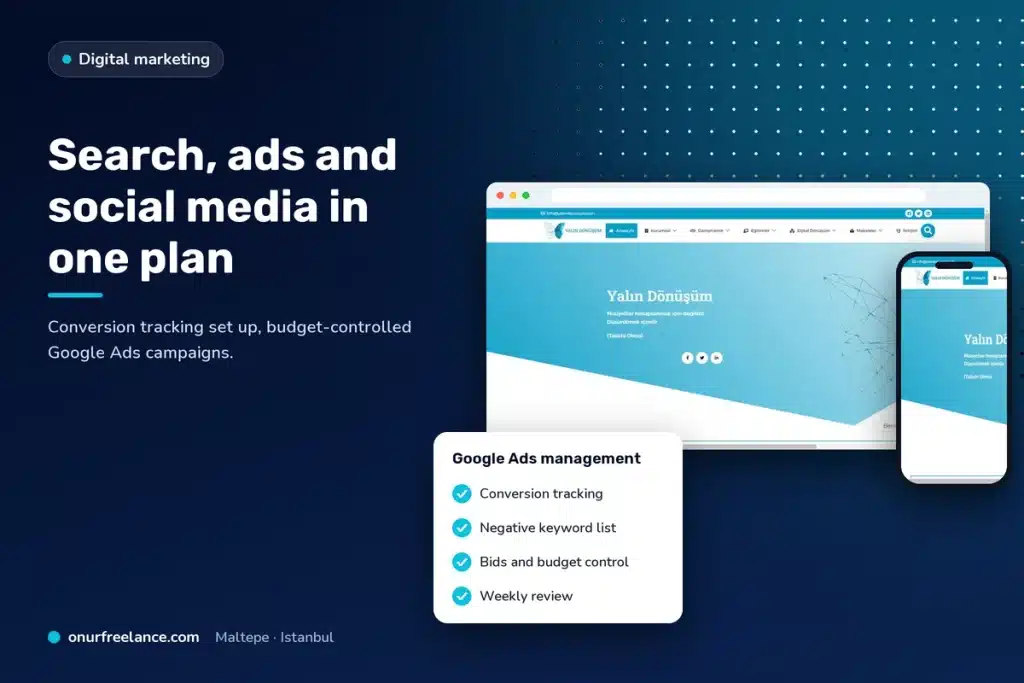
Efficient accounts use goal-appropriate campaign types, keywords and negative lists, and conversion measurement for every campaign. Ad spend is paid directly to Google from the business’s own account, separate from management fees. Setup and bidding strategies are explained on the Google ad management page.
Meta ad management: generating demand on Instagram and Facebook
Meta ads reach Instagram and Facebook users by interests, location, and behavior, making them suitable for reaching people before they search. They suit visual products, new businesses, and campaign announcements, and are often used to re-engage past visitors.
Campaign objectives such as awareness, traffic, engagement, leads, or sales must be selected correctly; boosting posts differs from planned campaign management. Meta Pixel and Conversions API enable measurement, while WhatsApp ads are tracked separately. Details are on the Meta ad management page.
Let’s decide which channel to launch first
We review the site, existing ad accounts, and recent inquiry sources before defining the initial channel and scope; a quote follows this review.
Social media account management: regular, consistent posting
Social media management means regular, consistent, audience-appropriate posting on accounts such as Instagram, Facebook, and LinkedIn. It builds ongoing follower relationships rather than buying reach.
The plan covers content schedules, brand language, visual layout, and message response times. Visitors arriving from ads inspect recent posts, comments, and activity, so neglected profiles weaken advertising too. Platform choice follows the audience: LinkedIn often comes first for B2B firms, Instagram for consumer brands. Scope appears on the social media management page.
Content marketing: answering customer questions
Content marketing builds trust and search visibility by answering pre-purchase questions through guides, blogs, comparisons, and FAQs. It fuels SEO; even well-built sites fall behind without new content. Within digital marketing, it supplies material for advertising and social channels too.
Topics follow real search queries, with each piece linked to a service page and next action. Content is adapted for newsletters and social posts across channels. Older articles are periodically reviewed to correct outdated information and expand weak sections. Details appear on the content marketing page.
Email marketing: repeat sales through a consent-based list
Email marketing encourages repeat sales and loyalty through campaigns, newsletters, and reminders sent to consenting customers and subscribers. Since the business owns the list, it is among the channels less dependent on platform algorithms. Although often left until later, a list collected from day one can become a low-cost sales channel.
In Turkey, commercial electronic messages require prior recipient consent. According to the Ministry of Trade’s İleti Yönetim Sistemi (İYS, Turkey’s commercial message registry) explanation, consents are held centrally and recipients can opt out in one place. Automated cart reminders, post-order thanks and care advice, or regular newsletters maintain contact with little effort. List building, segmentation, and automated flows are explained on the email marketing page.
Measurement: GA4 key events and UTM parameters
Measurement shows which channels generate real inquiries and supports budget decisions; it should be set up before launching channels. In Google Analytics 4, valuable business actions are marked as ‘key events.’ According to Google’s comparison of conversions and key events, ‘conversion’ now refers to Google Ads measurements used to assess advertising performance and inform bidding.
UTM tags are added to campaign links to separate channels in reports. The Analytics help center’s URL builder and UTM page defines utm_source, utm_medium, utm_campaign, and utm_content for distinguishing creative assets. Setup usually follows this sequence:
- List tracked actions: form submissions, phone clicks, WhatsApp clicks, purchases.
- Collect these as GA4 events and mark important ones as key events.
- Connect Google Ads and Meta accounts to measurement.
- Use consistent UTM naming for email, social media, and partner links.
- Review monthly channel reports and base decisions on the data.
A common error is treating every page view or click as important, making reports reflect activity rather than real inquiries. Counting the same action through both GA4 and the ad platform also misleads decisions. SEO clicks and impressions come from Search Console and are evaluated alongside GA4.
How should you approach ad budgets?
Budgets depend on inquiry value and industry competition rather than a fixed figure. Ad spend is paid directly to Google or Meta; management is separate, starting at 9,000 TL monthly for Google Ads and 7,500 TL monthly for Meta.
Key budgeting factors include:
- Average customer value and repeat purchasing
- Target area size and advertising hours
- Keyword competition and industry seasonality
- The site’s ability to convert visitors into inquiries
Start with a small testing period and shift spending toward effective campaigns as data grows, identifying waste early. SEO and content marketing need no direct ad budget; investment is in time and work, with later returns.
Digital marketing agency or one coordinated plan?
Businesses often give SEO, ads, and social media to separate providers. Each reports independently, without evaluating shared inquiry sources, and budgets may follow whoever reports most loudly.
Whether working with an agency or one coordinated specialist, expect channels managed under one goal and measurement framework. Onur Freelance follows this sequence:
- Review the website, accounts, and inquiry sources.
- Define the priority goal and initial channel.
- Set up or repair measurement.
- Start channel work and treat the initial period as testing.
- Use monthly reports and meetings to decide the next channel or budget.
Ad and analytics accounts are registered to the business, which retains access. Reports focus on calls, forms, and sales. Data and account history remain with the business after services end.
If a site is slow, broken on phones, or has a faulty inquiry form, marketing spend is wasted; first address web design issues. Work focused on district and side-specific search visibility in Istanbul is explained separately on the SEO agency in Istanbul page.
Let’s set up your first channel with measurement
Contact the same line to explore channel options, assess existing ads, or begin. Scope and quotes are confirmed after review.
Frequently asked questions
What is digital marketing?
Digital marketing uses search engines, ad platforms, social media, content, and email to reach the right people and turn contact into measurable actions. Its key distinction is tracking how many inquiries each channel generates.
Which channels do digital marketing services include?
SEO, local SEO, technical SEO, e-commerce SEO, Google and Meta ad management, social media management, content marketing, and email marketing. Start with channels suited to your goals rather than all at once.
Which channel should a small business start with?
Local SEO and Google search ads often come first for businesses with local customers. Meta ads suit visual products and new businesses, while SEO and content support long-term visibility without advertising dependence.
What is the difference between SEO and Google ads?
Google ads provide immediate visibility while budget is spent, stopping when ads stop. SEO builds visibility over time without pay-per-click costs. Together they balance short- and long-term demand.
When will digital marketing results appear?
Advertising data arrives shortly after launch. For SEO, Google says changes may take hours to months to show; no fixed ranking timeline or result is promised.
Who receives ad spend, and from which account?
Spending is paid directly to Google or Meta from the business’s own ad account. Management fees are separate and confirmed in a quote after scope review.
What is a key event in GA4?
A key event measures an action especially valuable to business success, such as a form submission, phone click, or purchase. Ad platform conversions informing bids rely on these measurements.
What should I look for when choosing a digital marketing agency?
Check that accounts belong to the business, measurement is configured, and reports focus on real inquiries, calls, forms, and sales. Be cautious of fixed ranking or result promises.