Restaurant website design is the planning and development of a website that brings a restaurant’s, cafe’s, or bakery’s menu, address, opening hours, and reservation and ordering channels together at one address and can be read on a phone in seconds. A good restaurant website goes beyond attractive photographs; it becomes the menu page opened by the QR code on the table, directs people wanting to reserve a table and those wanting delivery to separate channels, and matches the information on Google Business Profile exactly.
The following sections explain the page plan, how the menu is published, reservation and ordering links, the menu rules in the Price Label Regulation, structures for multiple branches and languages, and the items determining the price. Onur Freelance carries out this work from Maltepe, Istanbul; meetings with businesses in Istanbul take place on site or online, and those with businesses outside the city take place remotely.
Let’s start with a short message describing the menu and venue
A free preliminary assessment is carried out when the business type, number of branches, ordering platforms used, and current website address, if any, are shared in a single message. The proposal is sent the same day; a current photograph of the menu can also be attached.
Which pages should a restaurant website include?
The core of a restaurant website consists of the homepage, menu, location and contact, gallery, and a reservation or ordering page; catering, branch, and event pages are added according to the business’s services. In restaurant website design, the page plan is developed around the decision being made by the person opening the website. Someone looking for a restaurant is usually on a phone and wants to see four things quickly: where it is, whether it is open now, what they can eat, and the price range.
| Page | The guest’s question | What the page contains |
|---|---|---|
| Homepage | Is this place right for me? | Cuisine type, opening hours, one-tap calling, directions, menu button |
| Menu | What is available, and how much does it cost? | Categories, item name, brief ingredient description, price, update date |
| Reservations | Is there a table available tonight? | A form asking for the date, time, and party size, or a reservation phone line |
| Orders and delivery | Will they deliver to my home? | Platform buttons, ordering phone line, delivery area and hours |
| Location and contact | How do I get there? | Map, full address, transportation note, WhatsApp |
| Gallery | What kind of place is it? | Photographs of food, the dining room, garden, or terrace |
| About us and events | Can they host a celebration or group meal? | The business’s story, catering and group inquiry form |
A cafe website is often built more simply; the menu, hours, location, and a few photographs on a single page may be sufficient. For businesses with separate service lines such as catering or special occasion events, each line receives its own page and inquiry flow.
Menu page: HTML menu, PDF menu, and QR code
The menu is published as an HTML page written as text within the website; a PDF can be added as a backup for those who want one, while the QR code is a shortcut from the table to this page rather than a separate menu type. Because the menu page is the most frequently opened section of the website, speed, readability, and ease of updating are decisive here.
| Criterion | HTML menu page | PDF menu | Menu as a photograph |
|---|---|---|---|
| Reading on a phone | Flows to fit the screen, with no zooming required | Usually requires zooming | Small lettering is difficult to read |
| Price changes | The relevant row is edited in the dashboard | The file is prepared again and uploaded | The image is redesigned |
| Search and map results | Read as text and provided as a menu link | Can be crawled, but remains a single file | The lettering may not be readable as text |
In restaurant website design, the menu is divided into categories, with category shortcuts at the top of the page; someone viewing breakfast does not have to scroll past grilled dishes. Brief ingredient descriptions, prices for different units such as portions or weights, and the update date are displayed visibly.
The address opened by the QR code is kept permanent: when prices change, the page content is updated rather than the QR code, and printed materials on tables do not need replacing. The menu page is kept light enough to open quickly even on a weak mobile connection inside the dining room.
How are reservations set up on a restaurant website?
Reservations are set up in one of three ways according to the business’s number of tables and level of demand: a phone line that starts a call with one tap, a form collecting requests, or an existing reservation platform embedded in the website. The choice depends on who manages reservations and how.
- Reservation phone line: If table requests are taken by phone, the number appears in the top bar and reservation button; it is displayed separately from the delivery ordering line.
- Request form: Date, time, party size, name, phone, and notes are requested; a submission through the form is a request rather than a confirmed reservation and is confirmed by the business by phone or message.
- Reservation platform: A system showing real-time availability is embedded in the website using the provider’s method; its fee and contract are between the business and the provider.
Because forms collect personal data such as names and phone numbers, a link to the privacy notice is provided near the submit button. Consent for campaign messages is requested through a separate checkbox and is not made a prerequisite for a reservation.
How are online ordering platforms and the delivery area connected to the website?
The website of a restaurant offering delivery is built with clear buttons taking orders to the channels the business actually uses: its store page on platforms such as Yemeksepeti, Getir, or Trendyol Yemek, its own ordering phone line, or an ordering system operating within the website. Each button opens the business’s store page directly rather than the platform’s homepage.
The business decides which platforms to work with and the commission terms; these fees remain outside the website price. For businesses wanting to take orders without intermediaries, the cart and payment are set up within the website; this structure is planned within the scope of e-commerce website development .
The delivery area is explained on a single page listing the neighborhoods to which the business actually delivers and its delivery hours. Creating separate pages with identical content for every neighborhood gives visitors no new information and produces weak, repetitive pages.
Let’s define the menu, reservation, and ordering flow together
When the list of ordering platforms, how reservations are taken, and the number of branches are shared, the scope is put in writing; for structures with additional modules, the price is provided according to this scope.

What does the Price Label Regulation say about restaurant menus?
Price Label Regulation requires price lists at restaurants, cafes, bakeries, and similar establishments to be visible at the entrance and on tables; it allows the list to be displayed on tables through a QR code, but requires that the list also be provided separately to customers who request it. The main rules concerning menus appear in Articles 8 and 9 of the regulation:
- Article 8/1: The price list is placed in front of the establishment’s entrance, separately at each entrance if there is more than one, and on tables where service is provided, in a form that is easy to see and read.
- Article 8/2: Price lists may also be displayed on tables through QR codes; if a customer requests it, the price list must also be provided separately.
- Article 8/3: All products offered for service must appear in tariff and price lists.
- Article 8/6: Following the amendment published in Official Gazette No. 33153 dated January 30, 2026, and without prejudice to Article 51 of the Labor Law, no additional payment may be requested from consumers in these establishments under names such as service charge, table charge, cover charge, or any similar name.
- Article 9: Numbers and letters in the lists must be legible, complete, truthful, and contain no misleading information; prices are written with “Turkish lira,” “TL,” or the ₺ symbol.
The Ministry of Trade’s announcement concerning the amendment explains that these businesses cannot include statements in their menus indicating additional charges, that customers will not pay extra fees other than voluntary payments such as tips, and that charges cannot be requested for cover items brought to the table without being ordered. The regulation also envisages that establishments meeting criteria to be determined by the Ministry will transfer price list data to a system to be established.
The regulation directly governs lists at the establishment; because the website menu and the page opened by the QR code are the digital equivalent of that list, they are prepared under the same rules in restaurant website design. Prices match the list on the table and are written in TL, every product offered for sale appears on the menu, and notes left from old templates such as “service charge is not included in prices” are removed. Because Article 5 of the regulation also requires the date on which the price takes effect in service tariffs, an update date is shown on the menu.
Every restaurant website also includes a personal data privacy notice and a banner asking for cookie preferences. This section provides general information and is not a legal opinion.
How do Google Business Profile and a restaurant website work together?
Google Business Profile is the restaurant’s card shown on maps and in search; the website is the actual destination opened by the menu, ordering, and website links on this card, so names, addresses, phone numbers, hours, and prices are kept identical on both sides. Google’s menu editor help page states that food and beverage businesses can add menu items in sections with descriptions and prices, provide a menu link on the profile, and that changes can take 24-48 hours to appear on Maps and Search.
According to the same page, Google may transcribe menu data from the business website for display on the profile; when it finds multiple menu sources, the business selects its preferred source. Outdated or incorrect menu photographs uploaded by customers can be flagged for removal.
For ordering, Google’s online ordering options page explains that third-party providers’ links and the business’s own ordering links can be added to the profile, and a preferred provider can be selected for pickup and delivery. Detailed profile setup is covered in the Google Business Profile optimization guide .
Food photography and venue images
Real images of the dishes and dining room do more work than menu descriptions:
- The business’s own dishes and dining room are used instead of stock imagery; the portion in the photograph matches the portion served.
- Products in the same category are photographed from similar angles and with similar lighting.
- The gallery is divided into sections such as food, breakfast, the venue, and garden.
- Images are compressed before uploading, and the dish name is written in the alt text.
Regular sharing of these photographs on social media is work separate from the website and is planned within the scope of social media management .
What should the website structure look like for restaurants with multiple branches and in tourist areas?
For a business with multiple branches, each branch has its own page with its address, phone number, opening hours, menu, and QR code; for restaurants in tourist areas, the menu and basic information are published on separate language pages. A branch selector on the homepage takes guests to the correct branch, while the brand story is told in one place.
If prices or products differ between branches, each branch’s menu is kept separate and each branch’s Business Profile links to its own page. Google’s menu editor page states that the Business Profile API is required to update the same menu across multiple profiles; menu management for chains with multiple branches is discussed at the start of the project.
Automatic translation operating inside the browser is a quick solution, but it does not create a separate language page in search engines. For restaurants wanting to be found in another language, menus, hours, and location are published on separate translated pages and linked to one another with hreflang annotations. Translations of dish names are checked by a person; prices on foreign-language pages are also written in TL.
Two examples of projects in the food industry
Two of Onur Freelance’s projects in the food industry illustrate the difference between a promotional restaurant website and a food e-commerce website that takes orders.
Kaplan Kebap: a restaurant website focused on promotion and communication
For the kebab and döner restaurant in Maltepe, Kaplan Kebap , the website built on WordPress with Elementor Pro has two separate phone lines for orders and reservations in its top bar, both starting a call when tapped. The catering form collects the event type, number of people, and date at the outset; the photo gallery is divided into “Our flavors,” “Breakfast,” and “Venue.” A history page, job application form, map, fixed WhatsApp button, and KVKK (Turkey’s Personal Data Protection Law) and cookie texts in the footer are also part of the website.
Mirzade Baklavaları: a dessert e-commerce website that takes orders
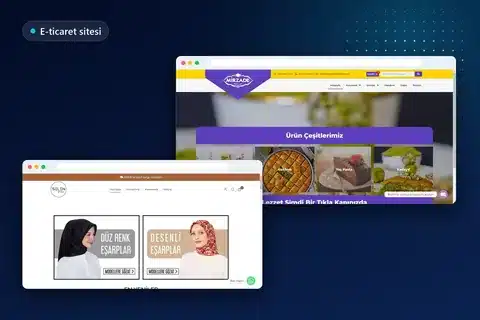
For the dessert business in Şanlıurfa, Mirzade Baklavaları , the store built with WooCommerce divides products into four categories: baklava, kadayıf, ice cream, and fresh cakes. Products are sold with 1-kilogram or tray options, and the description states that the tray charge is included in the price; alongside the cart and checkout pages, cash on delivery and WhatsApp contact are highlighted.
How does restaurant website development progress step by step?
Restaurant website development begins by learning about the menu and ordering channels, and the website is not launched before the QR menu and forms are tested on real phones. The steps are as follows:
- Initial meeting: Cuisine type, number of branches, reservation method, and ordering platforms used are discussed; following a free preliminary assessment, the proposal is sent the same day.
- Content collection: The current menu and prices, photographs, opening hours, addresses, and platform store links are requested in a single list.
- Page plan and design: The page list is approved, and the design is prepared for a phone screen first.
- Setup: WordPress is installed, the HTML menu is entered with its categories, and reservation and request forms are connected.
- Search infrastructure: Page titles, descriptions, the sitemap, and structured data defining restaurant information are added.
- Testing, launch, and training: QR codes, buttons, and forms are tested; the website is launched, and the business is shown how to update the menu through the dashboard.
A restaurant web design project with content ready and without a reservation platform, on-site ordering, or multiple languages is completed in an average of 5-7 business days. The domain and hosting are registered in the business’s name; for projects with additional modules, the schedule is determined once the scope is clear.
What changes the price of a restaurant website?
A single-page cafe website consisting of a menu, gallery, and contact information starts from 12,000 TL; a multipage promotional restaurant website starts from 15,000 TL within the corporate website package, and a structure that takes orders and payments within the website starts from 24,000 TL with the e-commerce package. The main items that increase or decrease a restaurant website design proposal are:
- The number of menu products and categories, and different sales units
- The number of branches and whether a separate menu is needed for each
- The language versions to be created and who will provide translations
- Whether reservations are taken through a form or an embedded platform
- Whether orders are taken through platform buttons or within the website
- Additional forms such as catering, events, or job applications, and migration of content from an existing website
Prices for additions such as a reservation module, multilingual structure, and branch pages are clarified in the proposal according to scope; reservation or ordering platform fees are paid directly to that service. After launch, updates, backups, and security checks continue through optional WordPress maintenance at 500 – 2,000 TL per month. A comparison of all packages appears on the web design prices page.
Common mistakes on restaurant websites and the correct method
Most mistakes on restaurant websites arise from failing to keep the menu current and the information guests seek becoming lost among photographs. A common practice is to change a ready-made theme’s demo content and add the menu as a single PDF or photograph; the file is not updated at the first price change, and the website begins to contradict the list on the table. In an approach that plans restaurant website design around the business, who will update the menu through the dashboard is determined first, and the design is built around that arrangement. Other common mistakes and their solutions are:
- Phone number inside an image: The number is written as text and starts a call when tapped.
- The ordering button goes to the platform homepage: The button links to the business’s own store page.
- The QR code opens an old address: If the menu address changes, the old address redirects to the new page.
- A service charge note left from the template: The menu and footer are reread in light of the 2026 amendment.
Onur Freelance’s working principles for restaurant projects are consistent: a written scope, a domain and hosting registered in the business’s name, a dashboard through which the business can update the menu, and clear communication without promises about visitors or orders.
Let’s plan everything from the QR code on the table to the order button
Questions from those seeking information about restaurant website design are answered, existing websites and menus are reviewed for businesses at the decision stage, and those ready to start receive the proposal the same day.
How website structures change in other industries is explained together on the industry-specific website design page.
The social media plan for menu content, reservation direction, and review management is explained on the restaurant social media management page.
Frequently asked questions
How much does a restaurant website cost?
A single-page cafe or small restaurant website starts from 12,000 TL, a multipage promotional restaurant website starts from 15,000 TL within the corporate package, and a structure taking orders within the website starts from 24,000 TL. Prices for additions such as a reservation module, multiple languages, and branch pages are clarified in the proposal according to scope.
Should a restaurant website menu be a PDF or an HTML page?
An HTML page written as text on the website is recommended for the menu; it can be read on a phone without zooming, prices are updated individually through the dashboard, and it can be provided as a menu link on Google Business Profile. A PDF can be offered additionally for those who want to download it.
Does a restaurant using a QR menu need to keep a printed price list?
Yes. Under Article 8 of the Price Label Regulation, the price list may also be displayed on tables through a QR code, but the list must also be provided separately if a customer requests it; the obligation to display a price list at the entrance also applies independently.
Can a restaurant menu list a service charge or cover charge?
No. Following the amendment made on January 30, 2026, restaurants, cafes, and bakeries cannot request additional payments under names such as service, table, or cover charges; the Ministry of Trade has announced that menus cannot contain statements to this effect. Voluntary payments such as tips are excluded.
Can Yemeksepeti, Getir, or Trendyol Yemek ordering be connected to the website?
Order buttons on the website link directly to the business’s store pages on these platforms, and the same links can be added as ordering options on Google Business Profile. Platforms’ commission and contract terms are between the business and the platform and are not included in the website price.
Can a reservation system be added to a restaurant website?
Yes; depending on demand at the business, reservations are set up through a one-tap calling line, a request form asking for the date and party size, or an existing reservation platform embedded in the website. If a platform is used, its fee is paid directly to the provider.
Does a restaurant with multiple branches need one website or a separate website for each branch?
Generally, a separate page for each branch within a single website is sufficient; each branch page includes its own address, phone number, hours, menu, and QR code. Each branch’s Google Business Profile also links to its own page.
How long does it take to prepare a restaurant website?
A promotional restaurant website with content ready and without a reservation platform, on-site ordering, or multiple languages is launched in an average of 5-7 business days. For projects with additional modules, the schedule is determined together once the scope is clear.

Call us
Call us for detailed information.
Let us call you!
Share your phone number and let us call you!