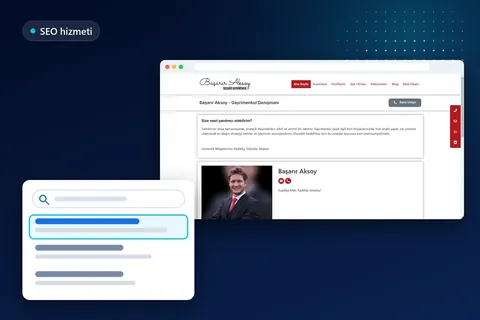
SEO for doctors is regular work on a website, Google Business Profile and content to help a physician, dentist or clinic be found in Google’s organic results and map results. In healthcare, this work proceeds differently from an ordinary clinic SEO package: every decision, from keyword selection to page titles, must remain within the boundaries of the promotion regulation dated November 12, 2025.
Since paid search advertising is largely unavailable to healthcare organizations serving domestic patients, the main sources of search engine visibility are organic results and the business listing on Google Maps. Onur Freelance is based in Maltepe; meetings with physicians in Istanbul can take place in person, while work in other cities proceeds online.
Free initial assessment of your clinic website’s search performance
When the website address, number of physicians and specialties, and Google Business Profile link are supplied, the current situation is reviewed. The initial assessment is free; once the scope is clear, a proposal is shared the same day.
Why is organic visibility the foundation in healthcare instead of advertising?
Organic visibility is the foundation in healthcare because the promotion regulation requires physicians’ and healthcare facilities’ search engine listings to be free, unsponsored and without a purpose of preferential promotion. Advertising spaces appearing above search results with a “Sponsored” label fall precisely within this definition. The rule appears in the text of the Regulation on promotion and information activities in healthcare services in issue 33075 of the Official Gazette, in subparagraph (i) of the first paragraph of Article 5.
The regulation provides two narrow exceptions to this restriction. A healthcare facility may conduct sponsored promotion complying with the regulation within the first month after opening; promotion of new medical technologies and methods medically accepted by the Ministry may also be permitted within this scope. Facilities holding health tourism authorization certificates may conduct sponsored promotion abroad on a separate website in official languages other than Turkish under Article 8.
Given this framework, Onur Freelance does not recommend Google Ads campaigns to physicians and clinics serving domestic patients. For healthcare projects, effort goes into the website’s search infrastructure, physician and specialty pages, and business listing.
Which promotion regulation rules apply to SEO content?
SEO content is subject to all principles of the regulation, just like every promotional and informative text on the website. The regulation also explicitly states that keywords used in search engines and information appearing on results pages cannot conflict with those principles. In healthcare SEO, page titles, meta descriptions and business information visible on Google therefore undergo the same review as the text itself.
| Rule in the regulation | Corresponding action in search work |
|---|---|
| Information about healthcare services may be provided only by a professional authorized in the relevant field (Art. 5/1-b). | The physician writes or approves treatment and disease articles; the byline includes the physician’s name and specialty. |
| Statements claiming treatment through unproven methods or methods not defined by the Ministry cannot be used (Art. 5/1-ç). | No pages are created for these methods, and their names are excluded from the keyword list. |
| Research results and statistics cannot be presented differently from what they actually show (Art. 5/1-ğ). | Outcome statements such as success rates and recovery times are not written into titles; sources are provided for cited studies. |
| Posts using patients’ or relatives’ thanks and satisfaction as advertising are prohibited (Art. 5/1-e). | Review quotations, review widgets and star ratings are not used on the website; ratings are not added to structured data. |
| Prices, discounts, campaigns or promotional offers cannot be announced (Art. 5/1-m). | Pages are not created for price-focused queries; titles do not contain phrases such as “affordable” or “discounted.” |
| Content must not directly or indirectly steer patients to a particular physician or organization (Art. 5/1-f and g). | Informational articles do not receive urgent appointment calls to action; contact information remains in a simple section. |
Before-and-after images, the presentation of physicians’ titles and conditions for health tourism websites are explained in detail in the healthcare website guide ; this page covers only the aspects directly affecting search work. It is also appropriate for the organization’s legal adviser to review texts before publication. This section provides general information and is not a legal opinion.
How does Google evaluate health content? YMYL and E-E-A-T
Google’s systems classify topics directly affecting people’s lives, such as health, financial stability and safety, as YMYL (“Your Money or Your Life”) and give even greater importance to content demonstrating strong experience, expertise, authoritativeness and trustworthiness (E-E-A-T) in these areas. The guide to helpful and reliable people-first contenton Google Search Central states that E-E-A-T is not a ranking factor on its own. The guide’s “Who, How and Why” questions translate to a physician’s website as follows:
- Who: Every informational article has a byline carrying the physician’s name and linking to their profile page; Google strongly recommends this byline.
- How: Sources used are stated; if automation or artificial intelligence was used in drafting, the final text is shown to have undergone physician review.
- Why: Topics are selected because patients ask about them during consultations, rather than for search volume; the guide considers content primarily intended to attract search traffic a warning sign.
The same guide also lists refreshing a date to make a page look current without significantly changing its content among behaviors that should be reconsidered. This detail determines how the update date required by the regulation is managed.
How are physician profile and specialty pages structured?
The foundation of a website’s structure in doctor SEO is one profile page for each physician and one information page for each specialty or treatment topic. Search queries fall broadly into two groups: those containing the physician’s name and those containing the name of a treatment, specialty or complaint. The first group leads to the profile page and the second to the specialty page; the two pages are linked.
The profile page is limited to information the regulation lists for professionals: academic title, main and subspecialties, days, hours and locations where patients are accepted, and preventive health information relevant to the field. Training within the registered specialty, Ministry-registered certificates, scientific publications and professional association memberships may also appear. However, a specialty title based on a certificate is written neither in the page title nor in the meta description (Art. 5/1-d). The following rules apply to specialty and treatment pages:
- Each page is assigned a single search intent; a blog post and service page are not both created for the same treatment to compete with each other.
- No page is created for a field in which the organization does not accept patients; the regulation prohibits promotion suggesting that patients are also accepted in other fields (Art. 5/1-c).
- The page describes the procedure, the complaints for which it may be considered and how the examination proceeds; it contains no outcome or time promises.
- In dentist SEO, topics such as implants, root canal treatment and orthodontics are addressed on separate pages, each linked to the relevant dentist’s profile.
- Pages with identical text duplicated under district names are not created; location information is kept on the contact page and business profile.
Update date, editor and review cycle
Subparagraph (ı) of Article 5 of the regulation requires informational articles on the website to display the last update date and clearly provide contact information enabling visitors to reach the website editor. On the search side, the date is visibly written on the page, matches the review field in structured data, and editor information remains fixed in every template.
The date changes only when the content has actually been reviewed. At each review, the physician reads the text, updates sources where necessary and records that day’s date; advancing the date without a meaningful change conflicts with Google’s warning.

Google Business Profile: how is local SEO performed for physicians and clinics?
Local SEO for physicians and clinics starts with keeping Google Business Profile compliant with both Google’s representation rules and the promotion regulation. The profile is a free listing, and the regulation allows healthcare facilities and professionals to register in search engines through listings that are unsponsored and do not seek preferential promotion. Google’s business representation guidelines list doctors and dentists among individual practitioners providing one-to-one services and set separate provisions for them:
- A physician who accepts patients at a verified address during specified hours can create their own profile; a title such as “Dr.” may appear in the profile name.
- If several physicians accept patients at the same address, a separate profile is created for the clinic; the physician profile name contains only the physician’s name, without the clinic name.
- If the physician is the only person meeting patients face to face at a branded organization, a single listing is created in the format “[brand]: [physician name].”
- A physician cannot create a separate profile for each specialty; support staff do not create profiles in their own names either.
- The business name reflects the real name used on signs and documents; the category field is not used to add keywords.
The regulation adds another layer to these rules. Prices are not entered in the profile’s service list, and campaigns or discounts are not announced in posts. Reviews patients leave on Google are not shared on the website or social media for advertising, gifts or discounts are not offered in exchange for reviews, and replies do not disclose information about a patient’s treatment. Setup steps appear in the Google Business Profile optimization guide, while the scope of regional work appears on the local SEO services page.
Let us clarify the scope for physician profiles and the business listing
Once the number of physician profiles, specialty pages and branches has been discussed, the monthly task list is documented. Any review widget, price wording or undated information article on the existing website is identified together in the first meeting.
Technical SEO and schema: Physician and MedicalClinic markup
Technical SEO enables a physician’s website to be crawled fully by Google, load quickly on mobile and communicate page meaning through structured data. The first audit checks indexing errors, HTTPS redirects, the sitemap and mobile speed; addresses without search value, such as form thank-you pages, are kept out of the index. Details are explained on the technical SEO services page.
The Schema.org vocabulary defines separate types for healthcare organizations, and the correct type is chosen according to the organization’s actual structure:
- Physician: represents a physician or physician’s practice as a healthcare organization; IndividualPhysician and PhysiciansOffice are subtypes.
- IndividualPhysician: describes an individual physician; the organization where they work is provided through practicesAt and the specialty through medicalSpecialty.
- MedicalClinic and Dentist: the former is for clinics dedicated to particular diagnoses and treatments, and the latter for dental establishments.
- MedicalWebPage: provides the information page’s last review date through lastReviewed and the physician who reviewed the text through reviewedBy.
Schema marks up only information visible on the page. Since the regulation prohibits sharing patient satisfaction and fee information, rating and review markup and the price range property are not used on physician websites. Markup does not mean a special appearance will be displayed in search results; Google’s own systems determine this.
Content calendar: how are preventive health articles planned?
A physician website’s content calendar is built around the health-protecting and health-promoting information defined by the regulation for informational activities; the regulation describes this as written or visual content that helps people increase control over their own health. Topics come from three sources: real queries visible in Search Console, questions the physician frequently hears during examinations and seasonal health issues.
| Content type | Search it addresses | Prepared and approved by |
|---|---|---|
| Specialty or treatment page | What a procedure is and how it works | Draft by the SEO team, text by the physician |
| Question-and-answer article | Practical questions before an examination | Physician answers and approves |
| Preparation guide | What to bring to an examination | Clinic team prepares, physician approves |
| Seasonal preventive information | Health searches increasing at particular times | Physician writes or approves |
| Review of an existing article | Pages losing visibility or containing outdated information | Physician reads, date is updated that day |
The calendar follows a monthly cycle: topics are listed at the beginning of the month, the SEO team prepares a draft containing the heading and question structure, the physician writes or corrects the text, and the approved text is published. The depth of existing pages matters more than the number of new articles; Google also regards producing content on many topics solely in the hope of rankings as a warning sign.
How is doctor SEO measured with Search Console and GA4?
Doctor SEO is measured through three sources: Google Search Console shows search visibility, Google Analytics 4 shows contact actions on the website, and the Business Profile performance screen shows interactions on maps. The main data tracked in the monthly report are:
- Impressions, clicks and average position for physician name, specialty and treatment queries in Search Console
- Pages not indexed and crawl errors
- Key events defined in GA4 for phone, WhatsApp and appointment forms
- Calls, directions requests and website clicks from the business profile
When measurement is configured, the contents of form fields are not sent to the analytics tool. Health data is special-category personal data; Article 6 of the promotion regulation also requires compliance with Law No. 6698 and the regulation on personal health data. Patient numbers or treatment outcomes are not the subject of the report; it shows which searches have changed in visibility and the following month’s work.
Common mistakes in SEO for doctors: usual practice and the correct approach
Most healthcare SEO mistakes arise from transferring habits that work in other industries onto a physician’s website. In usual practice, collecting customer reviews and displaying them on the website, opening a pricing page and using advertising to gather data quickly are ordinary steps; on a physician’s website, all three conflict with the regulation. Common mistakes and their correct alternatives are:
- Titles claiming superiority: Information on the results page is also subject to the regulation; the title states the physician’s name, registered specialty and topic.
- Review widgets and rating markup: These conflict with the ban on sharing satisfaction; trust is built through physician profiles and sourced content.
- Pages targeting treatment fees: These queries are removed from the keyword map.
- Ready-made texts published without physician approval: Every text passes through the physician.
- A separate business profile for every specialty: This violates Google’s rules and exposes the profile to suspension risk.
The common feature of the correct approach is that every page passes through the same checklist for search intent and the regulation before publication. For a website that has not yet been built, this check is performed during setup; the doctor and clinic website design page explains how a website is built according to the regulation from the outset.
How does the SEO service for doctors proceed, and what does it cost?
The SEO service for doctors begins with an initial analysis and continues each month with a written report; the monthly fee starts at 9,000 TL, and a firm proposal is provided after reviewing the scope. Work proceeds through the following steps:
- Initial analysis: Search Console data, website crawlability, the business profile and existing texts are reviewed against the regulation; the initial assessment is free.
- Compliance cleanup: Review widgets, price wording, assertive titles and undated information pages are listed and corrected together with the clinic.
- Keyword and page map: Physician names, specialties and treatment topics are assigned to individual pages.
- Technical corrections and schema: Indexing, speed and structured data issues are resolved in priority order.
- Content calendar: Drafts are prepared and published after physician approval.
- Monthly report: Completed work and search data are shared, and the next month’s plan is prepared.
The main items determining the fee are the number of physicians and branches, the number of specialty pages to be created, the website’s technical condition and competition in the targeted searches. The general service scope is explained on the SEO service page, and the pricing logic on the SEO prices page. No promises are made about rankings, patient numbers or results within a certain period; Onur Ertem manages the work, and every website change is recorded. If there is no website yet, setup is planned as a separate service.
Let us prepare the first month’s SEO plan for your practice or clinic
Questions from physicians seeking information are answered, existing websites and business profiles of undecided clinics are reviewed against the regulation, and those ready to start receive the first month’s task list and proposal the same day.
For clinics wishing to implement the work with their own team, the audit and roadmap model is explained on the SEO consulting page.
How the same legislation applies to channels outside search engines is explained on the social media management for doctors page.
Areas where a practice or clinic website falls short are identified through the technical and content checks covered in an SEO analysis .
Frequently asked questions
How much does SEO for doctors cost?
At Onur Freelance, SEO for doctors starts at 9,000 TL per month. A firm proposal is provided after reviewing the number of physicians and branches, specialty pages to be created, the website’s technical condition and competition.
Can doctors run Google Ads?
Largely no for domestic promotion; the promotion regulation allows only search engine listings that are not paid, sponsored or intended for preferential placement. Narrow exceptions include the first month after opening and a separate foreign-facing website for facilities holding health tourism authorization; Onur Freelance does not recommend Google Ads for healthcare projects.
How long does clinic SEO take to produce results?
No single timeframe can be given; results depend on the website’s current condition, competition in the specialty and how quickly content is approved. The first months complete technical corrections, compliance cleanup and the page map; no promises are made about rankings or patient numbers.
Can patient reviews be used in dentist SEO?
They cannot be used on the website or social media; the regulation prohibits posts that use patients’ or relatives’ thanks as advertising. Reviews patients leave on Google Business Profile remain on Google, but are not copied to the website, added as ratings in structured data or rewarded with gifts or discounts.
Who writes healthcare SEO content?
The physician writes or approves medical information; the regulation states that information about healthcare services may be provided only by a professional authorized in that field. The SEO team handles topic selection, heading and question structure, the draft and technical adjustments after publication.
Can a pricing page be created for SEO on a doctor's website?
No; the promotion regulation prohibits announcing prices, discounts, campaigns and promotions. Queries containing prices are removed from the keyword map, and price wording is not used in page titles.
Should a separate Google Business Profile be created for every physician?
A physician accepting patients individually at specific hours can create their own profile; if several physicians work at the same address, an additional profile is created for the clinic. Under Google’s rules, the physician profile name contains only the physician’s name, and one physician cannot create separate profiles for each specialty.
Can SEO work be done for a physician without a website?
Google Business Profile can be organized on its own, but a website is needed for the physician profile, specialty pages and information articles carrying update dates. Website setup is a separate service; pricing starts at 12,000 TL for a single-page site and 15,000 TL for a corporate clinic website.

Call us
Call us for detailed information.
Let us call you!
Share your number and let us call you!
Our other services
- › Corporate web design
- › E-commerce website development
- › WordPress website development
- › Google advertising management
- › SEO optimization