Real estate website design means building a website that brings a real estate office’s or consultant’s portfolio, service areas and team together at one address, receives authorization inquiries from property owners and meeting requests from prospective buyers and tenants. A good real estate website does not try to copy listing portals; it presents properties for sale and rent with understandable filters, publishes each listing with the information required by the regulation and connects visitors directly to the consultant through WhatsApp or call buttons.
This page describes Onur Freelance’s scope for real estate projects, portfolio and listing structure, options for working alongside portals, regulatory listing rules and pricing. Work is managed from Maltepe, Istanbul; meetings with offices in Istanbul take place face to face or online, and those outside the city are held remotely.
Let us clarify your office’s portfolio structure through a preliminary assessment
A short message describing the office’s service areas, average portfolio size and the portal currently used for listings is sufficient. Following the free preliminary assessment, a proposal is provided the same day.
What does real estate website design include?
The service combines page planning, design, portfolio structure, contact processes, search engine foundations and administration panel training in a single project. Standard scope consists of:
- Portfolio page: A list separating properties for sale and rent, filterable by location, price and room count.
- Listing detail template: A photograph gallery, listing information, location map and contact buttons leading to the consultant responsible for the listing.
- Property owner form: A separate page where people wishing to sell or rent their homes provide the property category and location.
- Company and team pages: The office’s working methods, areas of expertise and consultant profiles.
- Trust information: Authorization certificate number, office address, opening hours, SSL-encrypted connection, KVKK (Turkey’s Personal Data Protection Law) privacy notice and cookie banner.
- Delivery: The domain and hosting are registered in the business’s name, and panel training is provided for adding and updating listings.
The website is built on WordPress; office staff can add listings, update prices or unpublish sold properties through the panel. The general approach for consultant and independent professional websites is also described on the corporate web design page.
Property owners and prospective buyers: Two visitors to a real estate website
A real estate website serves two different visitors: property owners looking for a consultant to entrust with their properties and prospective buyers or tenants seeking listings. The information they examine when deciding differs; the first screen’s task is to direct each to the appropriate section. Property owners want to see which neighborhoods the consultant works in, how the sales process is managed and whom they will speak with. Prospective buyers want quick access to current listings, prices and the consultant.
This distinction is also reflected in the website menu. The ‘Portfolio’ link takes buyers to the listing inventory, while ‘Sell / Rent’ takes owners to the property submission form. Making both routes visible within the first scroll on the homepage allows visitors to find their role without searching.
Implementation on the Başarır Aksoy Gayrimenkul website
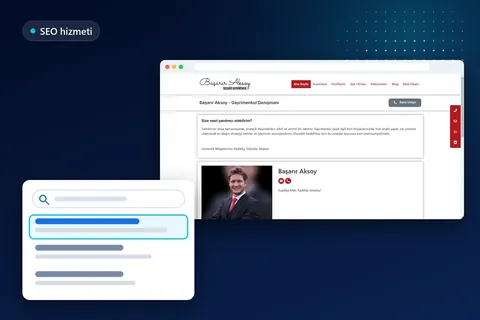
The Başarır Aksoy real estate website, created for a real estate consultant working in Kadıköy, Üsküdar and Beykoz from his office in Suadiye, Kadıköy, follows this structure. The homepage and Sell / Rent page contain the same property submission form; it asks whether the property is for sale or rent, whether it is residential, commercial or land, and its province, district and address, and includes a checkbox consenting to contact by a representative. The Portfolios menu link opens the consultant’s sahibinden.com storefront; the fixed side icon bar provides one-tap access to WhatsApp, email, telephone and the portfolio storefront.
Portfolio page: For sale, for rent and search filters
The portfolio page first separates properties for sale and rent, then offers filters allowing visitors to refine the list using their own criteria. The number of filters is determined by portfolio size; twenty filters create confusion for ten listings, while an unfiltered list is unusable for hundreds of properties. The filters most frequently needed on real estate websites are:
- Transaction type: For sale or for rent; short-term rentals or business transfers can be separate categories when necessary.
- Location: District and neighborhood, prioritizing the office’s areas of expertise.
- Price range: Minimum and maximum amount fields.
- Room count: Options such as 1+1, 2+1 and 3+1.
- Property type: Apartment, detached house, villa, commercial premises, land.
- Additional features: Options actually relevant to the office’s portfolio, such as being in a residential complex, parking, an elevator, furnished status or mortgage eligibility.
In real estate website design, filters are built as an expandable mobile panel and selections are not lost when the page reloads. Listing cards make the photograph, price, room count, floor area and neighborhood readable at a glance.
Listing detail pages and map usage
The listing detail page is where prospective buyers understand the property through written information after viewing photographs and contact the consultant; information fields are built as a template to be completed in the same order whenever a listing is entered. The template framework follows the information the regulation requires in listings: property size and age, location characteristics such as floor and orientation, number of rooms, living rooms, bathrooms and balconies, whether it is an apartment, in a residential complex or detached, and energy certificate information if available. Separate fields for ownership share, floor area ratio and planned building height are created for land.
The map should show the listing’s area while respecting the property owner’s privacy. The regulation requires province, district, neighborhood, cadastral block and parcel information rather than the street address; therefore, showing an area at neighborhood scale rather than a marker at door-number level is more appropriate for most offices. Writing approximate distances to public transportation stops, schools and parks as text gives visitors an idea without enlarging the map.
Photographs are uploaded in compressed modern formats. Videos or virtual tours, if available, are embedded to load when clicked; the listing page also opens quickly on mobile connections.

Sahibinden, Hepsiemlak and the website’s own portfolio
Most real estate offices publish listings on large portals such as sahibinden.com and hepsiemlak; the office website complements these portals by handling trust and branding needs they cannot fulfill. How the portal and website work together is selected according to the office’s listing count and the time staff can devote to entering listings. Three common approaches can be compared as follows:
| Method | How it works | Suitable office type |
|---|---|---|
| Link to the portal storefront | The Portfolio menu opens the office’s portal storefront; listings are updated in one place | A solo consultant or small office managing most listings through a portal |
| A separate listing module on the website | Listings are entered through the panel; filters, maps and listing detail pages are hosted on the website itself | An office wanting searches for its own brand and sharing listings on social media using its own address |
| Selected portfolio + portal link | Featured properties are published in detail on the website, with visitors directed to the portal storefront for the complete list | An office with a large portfolio wanting to showcase some properties separately |
Automatic transfer of portal listings to the website depends on whether the portal offers this facility and the office’s membership conditions; it is examined separately according to each project’s scope and is not promised beforehand. Portal membership or storefront fees are outside the website design fee and are paid directly to the portal.
Let us develop the listing process and page plan together
When the current listing portal, number of consultants and number of properties to publish in detail on the website are shared, the project scope is documented. Structures containing listing modules are priced on the basis of this scope.
Real estate trading regulation and EİDS: Website listing rules
Real estate businesses advertising online must comply with the listing rules in the Regulation on Real Estate Trading; listings on an office’s own website are also published online. Article 12 makes these businesses subject to subparagraphs (h), (ı), (i) and (j) of Article 14’s second paragraph and requires listings to contain no information or documents misleading third parties. In real estate website design, these provisions directly become template decisions:
- Required listing information (Article 14/2-i): The authorization certificate number, business name or title on the certificate, province, district, neighborhood, cadastral block and parcel information excluding the street address, other information listed in Article 15’s third paragraph, contact information and energy certificate information if available must be easily readable.
- Removal deadline (Article 14/2-h): When a property is sold or rented, withdrawn from sale or rental, or the authorization agreement is terminated or expires, listing activity must end within three days following that event.
- Limits of authorization (Article 14/2-ı and j): Listings may not contain provisions contrary to the authorization agreement; a business may not advertise properties it is not authorized to sell, market or rent.
- Price increases (Article 12/3): Online property listings may not have price increases inconsistent with general economic data and unsupported by a justified reason.
On the website, these rules are supported by mandatory fields in the listing form: the authorization certificate number and business title appear automatically on each listing page, cadastral block and parcel fields cannot be left blank, and sold properties can be unpublished in a single panel action. Under Article 11, the current list of authorized businesses is published on the Ministry’s website.
The Electronic Listing Verification System (EİDS, Turkey’s electronic property listing verification system) provides identity and authorization verification for listing platforms. According to the Ministry of Trade’s EİDS announcement, listings cannot be published on platforms without authorization verification since January 1, 2025; property owners authorize a certified business for at least three months through the EİDS Property Listing Authorization Procedures screen in e-Devlet, Turkey’s electronic government portal, and a property number is requested when entering the listing. The announcement also states that this listing authorization does not replace documents listed in the regulation, such as the authorization agreement. This section provides general information rather than legal advice.
Consultant profiles, WhatsApp and call conversions
In real estate website design, conversion means someone viewing a listing reaching the responsible consultant through the shortest route; contact buttons can therefore connect to the assigned consultant rather than the general office number. Each consultant receives a profile page listing their name, photograph, areas of expertise and own portfolio. The WhatsApp button on a listing page can prefill the message box with the listing number and title; the consultant does not need to ask which listing the inquiry concerns.
A fixed call and WhatsApp bar at the bottom of the phone screen saves visitors scrolling through a listing from searching for a button. The property owner form and listing inquiry form remain separate; the first asks about property category and location, while the second asks about the listing of interest and a suitable meeting time. KVKK privacy notices are shown separately in forms, while explicit consent for marketing communications is obtained through an independent checkbox. Form submissions and button clicks are measured as separate Analytics events, making it possible to see which listing or region generates inquiries.
Visibility for real estate offices in local searches
Real estate searches largely use neighborhood and district names; an office’s visibility in these searches depends on website area content and Google Business Profile supporting one another. Google’s Business Profile guidelines include real estate agents among individual practitioners; a consultant providing one-to-one services and directly reachable at a verified location during stated hours can create a profile. The same guidelines do not permit listings for virtual offices unstaffed during business hours.
On the real estate website, an original page can be created for each area of expertise, describing the neighborhood’s housing landscape, transportation and the office’s portfolio there; duplicating the same text with changed neighborhood names does more harm than good. The office name, address, telephone number and opening hours are written consistently in the profile and website. The Google Business Profile guide is available for profile setup; regular area content and Maps visibility are addressed under local SEO services as SEO work separate from the website project, starting at 9,000 TL per month.
How does a real estate website project proceed step by step?
A real estate website design project begins by learning how the office currently manages listings and does not launch before the listing entry process is tested with the team. The steps are:
- Preliminary discussion: Service areas, consultant count, current portal and portfolio size are discussed; after the free preliminary assessment, the proposal is provided the same day.
- Content collection: Authorization certificate information, consultant photographs and short biographies, office address, opening hours and example listings are requested in a single list.
- Page and field planning: The menu, filters and listing detail fields are approved; mandatory listing information is incorporated into the template.
- Design: Portfolio and listing pages are prepared for mobile screens first.
- Setup: WordPress is installed, and listing structures, forms, maps and contact buttons are connected.
- Testing and launch: Example listings are entered and removed to test the process; titles, the sitemap and Search Console connection are completed, and staff receive panel training.
An office website without a listing module, with its portfolio linked to the portal storefront and ready content, is completed within the standard corporate website timeframe of an average of 5–7 business days. If a separate listing module will be built, the schedule is agreed after clarifying the number of filters and volume of listings to transfer.
What determines the price of a real estate website?
A real estate office website linking its portfolio to a portal storefront is prepared within the corporate website package from 15,000 TL; a single-page consultant website consisting only of promotional content and a property owner form starts at 12,000 TL. There is no list price when a filtered listing module, map and consultant profiles will be built; these items are clarified according to scope in the real estate website design proposal. The main factors determining the proposal are:
- Whether listings will be kept on the website or directed to a portal storefront
- The number of filters, map usage and depth of listing detail fields
- The number of consultants and whether each will have profile and portfolio pages
- The number of area pages and who will prepare their content
- Whether listings, content and URLs must be migrated from an existing website
After launch, updates, backups and security checks can continue through optional monthly maintenance; the maintenance fee ranges from 500 to 2,000 TL, with details on the annual WordPress maintenance and updates page. Packages can be compared on the web design prices page, and a preliminary budget can be calculated using the website price calculator. If listing advertisements will be launched, Google Ads management is a separate service starting at 9,000 TL per month, excluding the advertising budget.
Common mistakes on real estate websites and the right approach
A common industry approach is to purchase a ready-made real estate theme and replace demo listings with a few office properties. When theme filters do not match the office’s portfolio, searches return empty results, leftover demo statements such as ‘thousands of listings’ are inaccurate, and listing detail pages lack a field for the authorization certificate number. In a real estate web design process planned for the office, listing fields and the contact process are identified first, and the design is built on that framework.
Other mistakes encountered on live real estate websites have similar roots: sold properties remaining online for months, the same listing carrying different prices on the portal and website, telephone numbers appearing only on the contact page, and an about us page without consultant photographs or an office address. The right approach is to manage listings from one source, remove them promptly when sold or rented and display trust information at the bottom of every page.
The working principle remains simple: written scope, domain and hosting registered in the business’s name, panel training and clear communication without ranking or sales promises. Examples from other industries appear on the references page.
Let us build your office’s own portfolio showcase
Questions from those seeking information are answered, existing websites and listing processes are reviewed for offices considering a decision, and offices ready to begin receive a proposal the same day. The first topic is always where listings will be managed and by whom.
How website structure changes across other industries is explained together on the industry-specific website design page.
Portfolio posts, video tours and social media organization complying with listing rules are also described on the real estate social media management page.
Frequently asked questions
How much does a real estate website cost?
A real estate office website linking its portfolio to the listing portal storefront starts at 15,000 TL within the corporate package; a single-page consultant website starts at 12,000 TL. For structures including filtered listings, maps and consultant profiles, the price is clarified in the proposal after reviewing scope.
Can listings be added and filtered on a real estate website?
Yes, a separate listing module can be built so listings are added through the panel and filtered by sale, rental, location, price and room count. The number of filters is determined according to the office’s portfolio size.
Are Sahibinden or hepsiemlak listings transferred automatically?
Automatic transfer depends on whether the portal offers this facility and the office’s membership terms; it is not promised beforehand and is examined according to scope. If transfer is unavailable, the Portfolio menu can link to the portal storefront or selected listings can be published separately on the website.
Is an authorization certificate number required in a property listing?
Article 14 of the Regulation on Real Estate Trading requires listings to display the authorization certificate number, business name or title, province, district, neighborhood, cadastral block and parcel information, and contact details in an easily readable format. This information is built into the listing template to appear automatically on each listing. This answer is general information rather than legal advice.
When should a sold property listing be removed?
Under the regulation, listing activity must end within three days after a property is sold, rented or its authorization agreement ends. The website is configured so unpublishing a listing takes a single action in the panel.
Does EİDS affect the real estate office's own website?
EİDS is the Ministry of Trade’s identity and authorization verification system for listing platforms; since January 1, 2025, listings cannot be published on platforms without authorization verification. The regulation’s listing rules also apply to listings on the office’s own website; legal advice should be sought for specific circumstances.
Can a real estate consultant create a separate Google Business Profile?
Google’s guidelines include real estate agents among individual practitioners; a consultant offering one-to-one services and directly reachable at a verified location during stated hours may create a profile. The profile name, address and telephone number are kept consistent with the website.
How long does it take to prepare a real estate website?
In real estate website design, an office website with ready content and a portfolio linked to the portal storefront launches on the standard schedule of an average of 5–7 business days. If a separate listing module is built, the timeframe is determined after clarifying the number of filters and volume of listings to transfer.

Call us
Call us for detailed information.
Let us call you!
Share your number and let us call you!