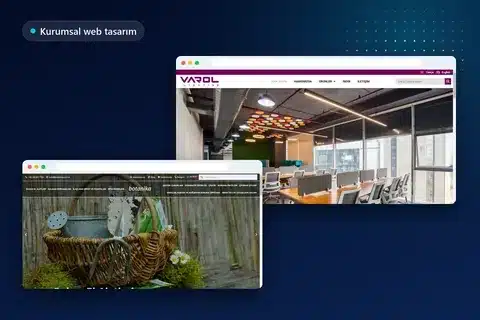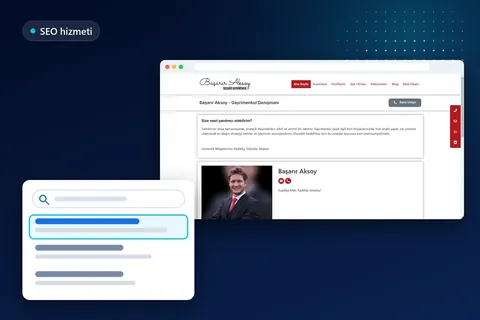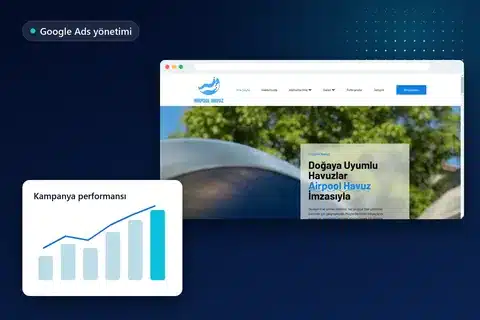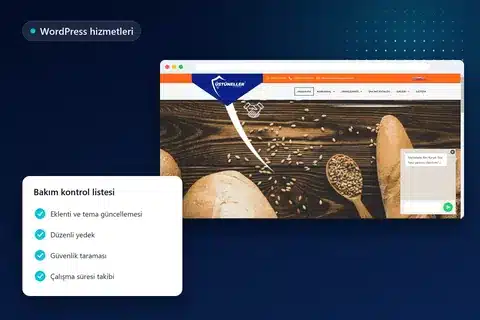
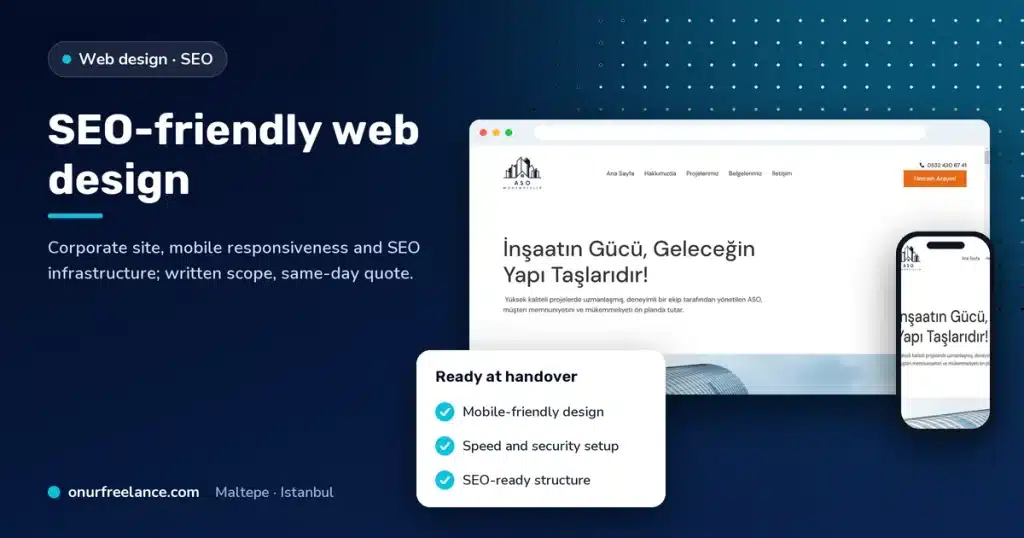
SEO-friendly web design means building a website from the design stage so that search engines can easily crawl and understand it. A Google-friendly website loads quickly, works smoothly on mobile, presents pages in a logical hierarchy, and clearly indicates what each page covers through its headings.
Many businesses commission the website first and think about SEO afterward. In that situation, the page structure, addresses, and even the design itself need to be reconsidered. With a website built to be SEO-friendly from the start, this cost never arises.
Get a proposal for a new website project
We clarify the scope according to your industry, page count, and goals, then prepare a free proposal for an SEO-friendly website.
SEO decisions made during the design stage
A website’s search engine performance is largely determined by decisions made while drawing the first draft. On an SEO-friendly website, the following topics are planned together with the design:
- Website architecture: services, areas, and content are grouped in a logical hierarchy; important pages are accessible within at most two clicks from the homepage.
- URL structure: short addresses that avoid problems with Turkish characters and describe the page’s subject are used.
- Heading hierarchy: a single H1 on every page, with H2 and H3 headings dividing the subject into sections, is included in the design template from the outset.
- Internal linking plan: service pages, related blog posts, and location pages are linked to each other.
- Structured data: business information, address, and contact details are added in a format search engines can read.
Speed and Core Web Vitals: The effect of design on performance
Google uses metrics called Core Web Vitals to measure page experience: loading time of the largest content element (LCP), response time to interactions (INP), and layout shift (CLS). How these metrics are measured is explained in detail on web.dev.
On the design side, the elements affecting speed most are heavy images, unnecessary animations, numerous third-party scripts, and large backgrounds that load late in the first screen. In SEO-friendly design, images are prepared in WebP format at the correct dimensions, the main image in the first screen is prioritized, and the plugin count is limited to what is needed. Technical details are discussed in the Core Web Vitals guide.
Why is mobile-first design necessary?
Google bases website rankings on the mobile version rather than the desktop version (Google Search Central). Content missing on mobile may not be considered even if it exists on desktop.
In mobile-first design, menus, contact buttons, and forms are planned first for small screens. Touch targets are kept large enough, text is readable without zooming, and phone and WhatsApp buttons are easily accessible on every page.
When content and design are planned together
Design is often created before content is ready; text is then squeezed into boxes afterward. With this approach, either the content is shortened or the design breaks. In the SEO-friendly web design process, we first determine which questions each page must answer, then design the most readable way to present that content.
For example, on a service page, visitors should see answers to ‘what do you do, whom do you do it for, and how can I contact you’ in the first screen. The process, frequently asked questions, and references appear further down in sections separated by headings. This arrangement helps users quickly find what they want and search engines correctly understand the page’s subject.
SEO afterward or an SEO-friendly website from the start?
It is certainly possible to carry out SEO work on an existing website. However, some structural problems cannot be fully resolved without rebuilding the website.
| Topic | Website with SEO added afterward | Website SEO-friendly from the start |
|---|---|---|
| Page structure | Usually requires reorganization | Planned around target keywords from the outset |
| Speed | Improvements limited by heavy themes and plugins | Starts with lightweight infrastructure and optimized images |
| Address (URL) changes | Carry risks from redirects and ranking losses | Addresses are permanent from day one |
| Total cost | Design and corrections are paid for twice | Correct setup in a single process |
If the website is already live and the issue only involves content or technical settings, proceeding with SEO services may be more appropriate than redesign.

How is an SEO-friendly website prepared? Project steps
- Discovery and keyword research: the business’s services, target areas, and customers’ search behavior are examined.
- Sitemap and page plan: we determine which page will address which search.
- Design: a fast-loading, mobile-first interface matching the brand identity is prepared.
- Development: heading structure, meta fields, structured data, and the sitemap are configured on WordPress.
- Content placement: pages are written around the user’s question rather than a keyword.
- Launch and checks: Google Search Console is connected, the sitemap is submitted, and speed and mobile tests are performed.
Preventing SEO losses when launching a new website
The problem businesses most frequently face when renewing an existing website is a drop in traffic after the new website goes live. This generally happens because old addresses are not correctly redirected to new ones, and pages Google recognizes suddenly disappear.
In redesign projects, all addresses on the old website are listed, each is connected to its new equivalent through a 301 redirect, and errors are monitored in Search Console after launch. Where an infrastructure change is required, the WordPress website migration process is handled with the same care.
Who needs SEO-friendly web design?
- Businesses commissioning their first corporate website and expecting to acquire customers through Google
- Companies whose current website is slow, problematic on mobile, or difficult to manage
- Businesses serving particular districts and cities that want visibility in local searches
- Brands wanting to reduce dependence on advertising budgets and establish lasting organic traffic
For projects emphasizing corporate identity, the corporate web design page can also be reviewed.
Should the existing website be renewed or improved?
By examining the website’s speed, mobile compatibility, and indexing status, we can clarify together whether renewal or improvement is needed.
Infrastructure ready for local searches
For businesses offering services in a particular area, SEO-friendly web design also means incorporating local signals from the beginning. The address, phone number, and business hours are written in the same format across all pages and match the details in Google Business Profile exactly. A map and directions are added to the contact page, and business information is communicated to search engines through structured data.
For businesses serving multiple districts or cities, location pages are planned as original pages written around the area’s business structure and customer needs, rather than copies of a template. Since we are based in Maltepe, face-to-face meetings with businesses on Istanbul’s Anatolian side can also be arranged easily.
SEO checklist before launch
An SEO-friendly website undergoes the following checks before launch. This list aims to catch errors before publication that could take weeks to identify and correct afterward.
- Does every page have a single H1, a page-specific title tag, and a meta description?
- Have descriptive alternative text and appropriate file sizes been used for all images?
- Has a sitemap been created, and have unnecessary pages such as test pages and archives been excluded from indexing?
- Are HTTP and www variations permanently redirected to a single address?
- Are mobile speed tests and Core Web Vitals values within acceptable ranges?
- Have the contact form, phone button, and WhatsApp button been tested on real devices?
- Have Google Search Console and Analytics been connected and conversion events defined?
Common mistakes in SEO-friendly design
- Writing text inside images: text in sliders or banners is not read by search engines; important information should appear as HTML text.
- The same title and description on every page: pages cannot be distinguished, and click-through rates in search results decline.
- Location pages duplicated with template content: pages that are copies of each other may not be indexed.
- A heavy first screen: large autoplay videos and uncompressed background images significantly reduce mobile speed.
- Not connecting Search Console: post-launch errors can continue for months without being noticed.
Criteria determining the price
The price of SEO-friendly web design varies according to page count, custom design needs, multilingual structure, additional modules such as e-commerce, and who will prepare the content. Current packages and starting prices are on the web design prices page; a project-specific proposal is prepared once the scope is clear.
Our working approach
At Onur Freelance, design, development, and SEO are handled by the same team. This allows issues such as a section drawn by the designer affecting speed or heading structure to be identified and resolved before project completion. After launch, the website is monitored through Google Search Console, and crawl errors appearing in the first weeks are corrected. For a checklist-format overview, see the article on how to make a website SEO-friendly.
Related guides
Frequently asked questions
What is the difference between SEO-friendly web design and regular web design?
In regular design, appearance is the priority; in SEO-friendly design, page structure, speed, mobile experience, and how search engines understand content are planned from the outset alongside appearance.
Does an SEO-friendly website immediately rank highly on Google?
No. SEO-friendly infrastructure prepares the foundation needed for rankings; reaching top positions depends on content, competition, and authority built over time.
Can my existing website be made SEO-friendly?
In most cases, yes. Speed, heading structure, and meta fields can be corrected on the existing website. If the infrastructure is very old or structural problems are extensive, renewal may be more economical.
Which platform do you use?
WordPress is used primarily for corporate websites. Adding content through the administration panel is easy, and SEO plugins offer flexible meta and schema management.
Will existing rankings be lost during website renewal?
If old addresses are correctly redirected to new pages, ranking losses are minimized. Monitoring continues through Search Console for a few weeks after launch.
Who prepares the content?
The business can supply its own text, or content can be prepared according to SEO rules within the service. This choice is one of the criteria affecting the price.
Is support provided after launch?
Yes. Technical checks are carried out after launch; work can continue with optional monthly SEO and maintenance support.
How can you tell whether a website is SEO-friendly?
The quickest way is to examine page indexing and Core Web Vitals reports in Google Search Console. In addition, each page is checked for a single H1 and original title tag, along with mobile appearance and loading speed. The existing website’s condition in these areas can be reviewed together in a free initial assessment.
Does SEO-friendly web design guarantee the first page?
No; Google’s own SEO guide explicitly states that nobody can guarantee a number-one ranking on Google. SEO-friendly infrastructure makes the website easier to crawl and understand, while rankings depend on content quality, competition, and time. Offers accompanied by ranking guarantees should therefore be evaluated cautiously.
Is a perfect speed test score necessary for SEO?
No; the Core Web Vitals report in Search Console is based on data collected from real visitors rather than a laboratory score. Instead of chasing a perfect score, the aim is a quickly loaded first screen, immediate response to touches, and no layout movement during loading. For existing slow-loading websites, speed optimization can also be carried out separately.
Is using a mobile-friendly theme enough?
It is not enough; even if a theme adapts to a small screen, how content, menus, and buttons work on a phone must be checked separately. Because Google bases rankings on the mobile version, text, headings, and links on desktop must also appear completely on mobile. Hidden mobile sections, small touch targets, and pop-ups covering the screen are the most common problems.
Where do you start when making an existing website SEO-friendly?
The first step is an audit revealing the website’s technical condition; pages not indexed, crawl errors, speed, and heading structure are examined. Findings are prioritized: first, issues preventing Google from seeing pages, then content and internal linking adjustments. These audits and corrections are handled within technical SEO services.
Does installing an SEO plugin on WordPress make a website SEO-friendly?
Not on its own; an SEO plugin is a tool that makes managing meta fields, sitemaps, and schema settings easier. Page hierarchy, speed, mobile experience, and content satisfying search intent are matters outside the plugin that are resolved during design and development. The process of building WordPress websites is explained on the WordPress website development page.
Does structured data (schema) improve rankings?
Structured data is not a procedure that raises rankings on its own; it helps Google understand the business, service, and contact information on a page more accurately. Correctly marked-up pages may become eligible for certain rich result types, but Google does not guarantee their display. Information in the markup must match the visible page content exactly.
How long does it take to see results from an SEO-friendly website?
No definite timeframe can be given; according to Google’s SEO starter guide, some changes are reflected within hours, while others may take months to show effects. The same guide says evaluating the benefit of work may often require waiting a few weeks. Regular work after launch is planned within SEO services.
A brief consultation is enough for the right start
You can get in touch to obtain information, assess your existing website, or request a proposal for a new project.

Our other services
- › Corporate web design
- › E-commerce website development
- › WordPress website development
- › Google Ads management
- › SEO optimization
Service areas
- › Web design in Kartal
- › Web design in Maltepe
- › Web design in Ataşehir
- › Web design in Istanbul
- › Web design in Zeytinburnu
- › Web design in Adalar
- › Web design in Arnavutköy
- › Web design in Avcılar
- › Web design in Bağcılar
- › Web design in Bahçelievler
- › Web design in Başakşehir
- › Web design in Bayrampaşa
- › Web design in Beykoz
- › Web design in Büyükçekmece
- › Web design in Çatalca
- › Web design in Çekmeköy
- › Web design in Esenler
- › Web design in Esenyurt
- › Web design in Eyüpsultan
- › Web design in Gaziosmanpaşa
- › Web design in Güngören
- › Web design in Kağıthane
- › Web design in Küçükçekmece
- › Web design in Sancaktepe
- › Web design in Sarıyer
- › Web design in Silivri
- › Web design in Sultanbeyli
- › Web design in Sultangazi
- › Web design in Şile
- › Web design in Beylikdüzü
- › Web design in Fatih
- › Web design in Bakırköy
- › Web design in Beyoğlu
- › Web design in Antalya
- › Web design in İzmir
- › Web design in Sakarya
- › Web design in Tekirdağ
- › Web design in Bursa
- › Web design in Beşiktaş
- › Web design in Şişli
- › Web design in Tuzla
- › Web design in Ümraniye
- › Web design in Kadıköy
- › Web design in Ankara
- › Web design in Üsküdar
- › Web design in Kocaeli